
Global warming is accelerating, remaining carbon budgets are shrinking, and the stability of key parts of the Earth system is under increasing scrutiny. As new evidence continues to emerge, policymakers are being asked to take long-term decisions on mitigation, adaptation and future research priorities. With this in mind, six European Union funded projects have brought together their latest Earth system research through a joint science–policy dialogue and a subsequent policy briefing.
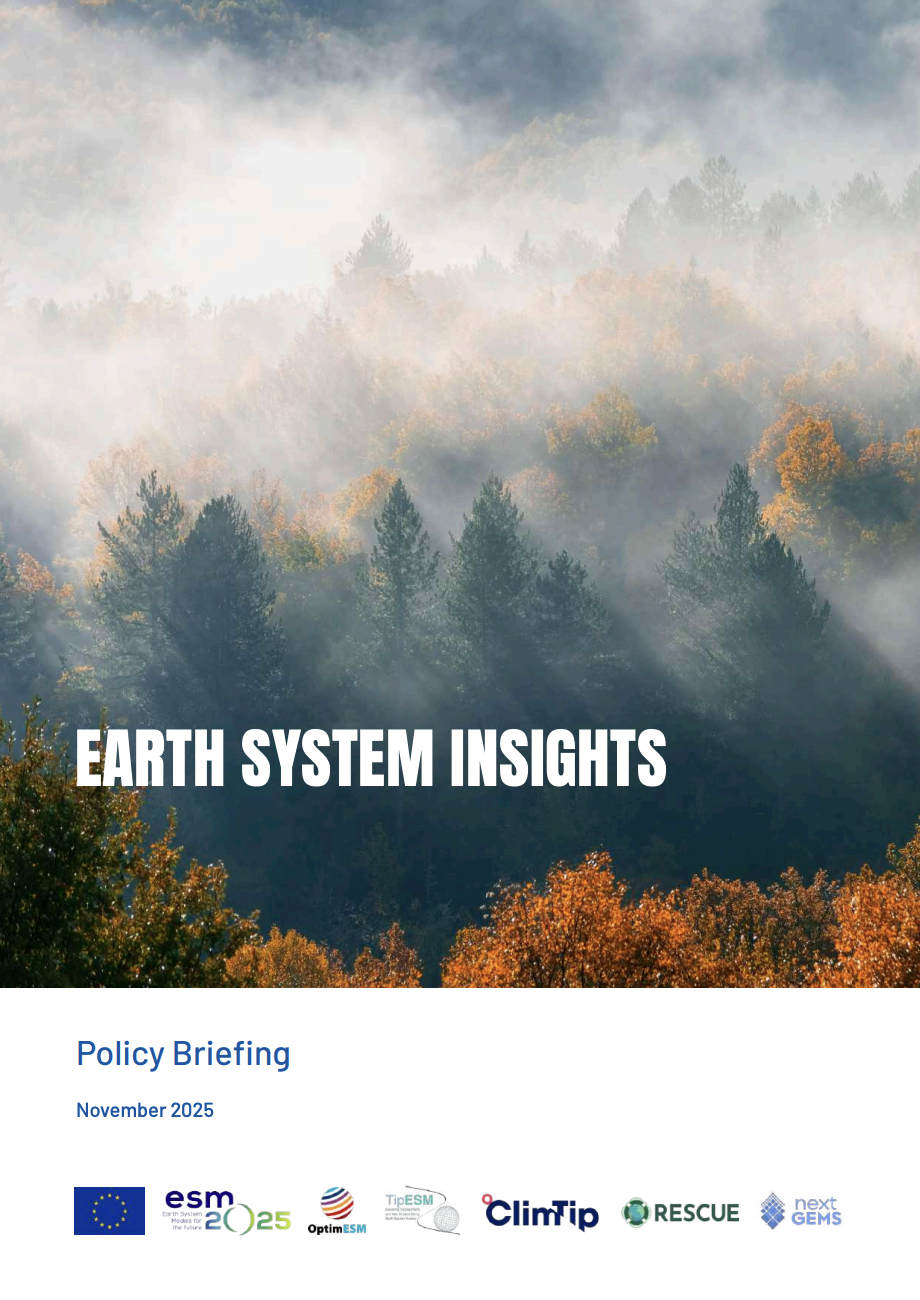
The briefing, titled Earth System Insights, draws on research from ESM2025, ClimTip, OptimESM, TipESM, nextGEMS and RESCUE. All six projects use advanced Earth system models to assess how human emissions are changing the climate, how effective mitigation strategies may be, and how vulnerable key components of the climate system are to further warming. Published in November 2025, the briefing synthesizes recent findings with direct relevance for European decision-makers.
From science–policy dialogue to a joint briefing
The policy brief builds on discussions held at a Science2Policy forum in Brussels on 25 September 2025, which brought together researchers from the six projects with policymakers and policy teams from the European Commission’s Directorate-General for Research and Innovation (DG RTD) and Directorate-General for Climate Action (DG CLIMA). Around 18 participants attended in person, with another 30 joining online.
The meeting included input from DG CLIMA on foresight, economic analysis and climate modelling needs, alongside a joint scientific presentation from representatives of the six projects. Rather than serving as a one-off exchange, the forum was conceived as a starting point for continued collaboration. In the weeks that followed, the projects worked together to translate the scientific insights discussed in Brussels into a shared policy briefing.
This bottom-up collaboration was initiated by the members of Climate Research Communication Network consisting of communication and project management teams within the Horizon project community, reflecting a broader effort to coordinate outreach and strengthen engagement with policymakers. For ClimTip, participating in this joint process aligns with its objective of contributing responsibly to policy-relevant discussions on climate tipping points and Earth system risks.
What the policy brief shows
Earth System Insights is structured around four questions that are central to current climate policy debates.
How fast is the climate changing, and what does this mean for risk?
Using updated indicators of global climate change and recent modelling results, the briefing shows that human-induced warming is increasing at an unprecedented rate. The remaining carbon budget consistent with the Paris Agreement temperature goals has narrowed further, influenced in part by recent record-warm years.
How effectively can mitigation efforts stabilize global temperatures?
The briefing confirms that reaching net zero carbon dioxide emissions remains essential to halt further warming. However, it also highlights uncertainty in how the Earth system may respond after net zero is reached. If emissions are reduced to net zero at high levels of warming, global temperatures may continue to rise for a time, increasing long-term climate risks.
What are the limits of carbon dioxide removal?
New Earth system modelling suggests that some land-based carbon dioxide removal approaches may deliver less carbon removal in practice than assumed in widely used scenarios. Ecological constraints, climate feedbacks and disturbance risks all affect how much carbon can be reliably removed and stored. These findings reinforce the importance of early and sustained emissions reductions as the most dependable way to limit future warming.
Stability, tipping points and regional impacts
How stable are key parts of the Earth's climate system?
The briefing highlights growing evidence that some major components of the Earth's climate system are vulnerable to continued warming. Tipping elements such as the Greenland ice sheet and the Atlantic Meridional Overturning Circulation may not fully recover even if global temperatures stabilize later this century. The briefing also notes that climate impacts will vary strongly by region, with parts of Europe projected to warm faster than the global average.
Why this matters for European policy
These findings underline the scale of the challenge facing European climate policy. Decisions on mitigation pathways, adaptation planning and future research funding must account not only for expected warming trends, but also for uncertainties in Earth system responses and the possibility of abrupt or irreversible changes.
Our joint policy briefing aims to support this process by providing a consolidated, cross-project assessment of recent Earth system science in a format accessible to policymakers. By pooling expertise across six Horizon Europe projects, the briefing offers a clearer picture of where scientific understanding is robust, where uncertainties remain, and where further research is most urgently needed.
For ClimTip, the Earth System Insights briefing complements earlier engagement with EU institutions, including policy workshops and briefings on climate tipping points and their implications for governance and resilience. Together, these efforts reflect a sustained dialogue between the climate research community and European policymakers.
As climate risks continue to evolve, such coordinated science–policy exchanges can help ensure that decisions on mitigation, adaptation and research priorities are informed by the best available understanding of how the Earth system is changing.
Download the policy brief here.
Reference: Mahika K. Dixit, Jenny Bird, Joeri Rogelj, Sebastian Bathiany, Kuat Abeshev, Thomas Rackow, Roland Séférian, Mariana Rocha, Hazel Jeffery, Torben Koenigk, Shuting Yang, Nico Bauer (2025) Earth System Insights – Policy Briefing.
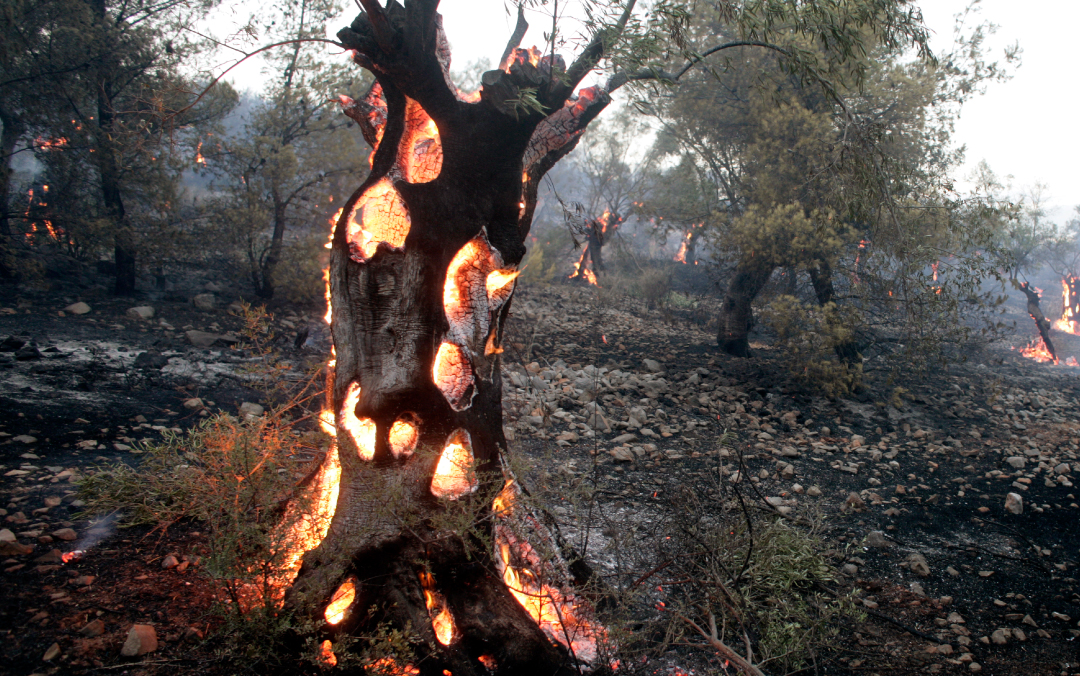
Opener image: Olive trees burn during a wildfire in Greece. Image credit: milos bicanski / Climate Visuals Countdown.