
The Amazon is often imagined as a single, continuous rainforest, but its stability depends on a network of interacting processes: how moisture recycles across the basin, how global markets drive land-use choices, and how quickly temperatures rise. In this webinar, Julia Pongratz (LMU Munich), who was recently named among Clarivate’s Highly Cited Researchers 2025, offered a wide-angle view of how these forces shape the forest today and what Earth system models say about the decades ahead.
The talk brings together insights from observations, Earth system models and new simulations from work by Julia Pongratz and colleagues that is now published in the Proceedings of the National Academy of Sciences (PNAS).
Past and present: pressures accumulating
Roughly 17% of the original Amazon forest has been cleared in recent decades, mostly for soy and cattle production. But Pongratz highlighted another, less visible trend: about 38% of the remaining forest is now degraded by fire, edge effects, selective logging, extreme drought, or combinations of these stressors. Degradation erodes resilience long before the forest disappears from satellite images.
Climate change amplifies these impacts. Higher temperatures and more frequent droughts have already reduced the Amazon’s CO₂ uptake. During the 2023–24 El Niño-linked drought, weakened carbon absorption in the Amazon contributed to a noticeable drop in the global land carbon sink.
What models suggest for the 21st century
Drawing on simulations from four Earth system models with dynamic vegetation, Pongratz and colleagues explored a range of futures. Their findings show:
- Up to 38% of the 1950 forest area could be lost by 2100
- Land-use change remains the dominant pressure below 2 °C of warming
- Beyond ~2.3 °C, the risk of abrupt, rapid forest decline increases sharply
- Continued deforestation alone could cross the critical 20–25% threshold identified by earlier tipping-point studies
The picture that emerges is highly nonlinear: change may appear slow for decades, only to accelerate once a threshold is crossed.
Untangling drivers remains difficult
Pongratz stressed a challenge inherent to Amazon research: the forest does not respond to single drivers in isolation. Climate change, deforestation, economics, fire regimes and local governance all interact, making attribution difficult and model projections more uncertain.
Better representation of forest degradation, vegetation responses and drought impacts, along with improved observations, will be essential for narrowing that uncertainty.
Why this matters
The Amazon’s future extends far beyond climate metrics. It shapes rainfall patterns across South America, supports over 10% of the world’s species, sustains millions of people, and stores vast amounts of carbon. Whether it remains a functioning rainforest, transitions to a more degraded state, or risks abrupt decline will depend on policy choices, land-use decisions, and global emissions trajectories over the coming decades.
Watch the Full Talk
The recording of this webinar is available on our YouTube.
Based on work by Julia Pongratz and colleagues including Selma Bultan, Lucas Ferreira Correa, Sebastian Bathiany, Niklas Boers, Raphael Ganzenmüller, Gergana Gyuleva, Yiannis Moustakis and Clemens Schwingshackl.
Reference: S. Bultan, Y. Moustakis, S. Bathiany, N. Boers, R. Ganzenmüller, G. Gyuleva, & J. Pongratz, Amazon forest faces severe decline under the dual pressures of anthropogenic climate change and land-use change, Proc. Natl. Acad. Sci. U.S.A. 122 (50) e2418813122, https://doi.org/10.1073/pnas.2418813122 (2025).
Find more talks on the ClimTip YouTube channel to find more webinars on science of climate tipping points.
In Case You Missed It
Watch the November webinar with Sacha Sinet on how West Antarctic meltwater could stabilize the Atlantic Ocean currents.
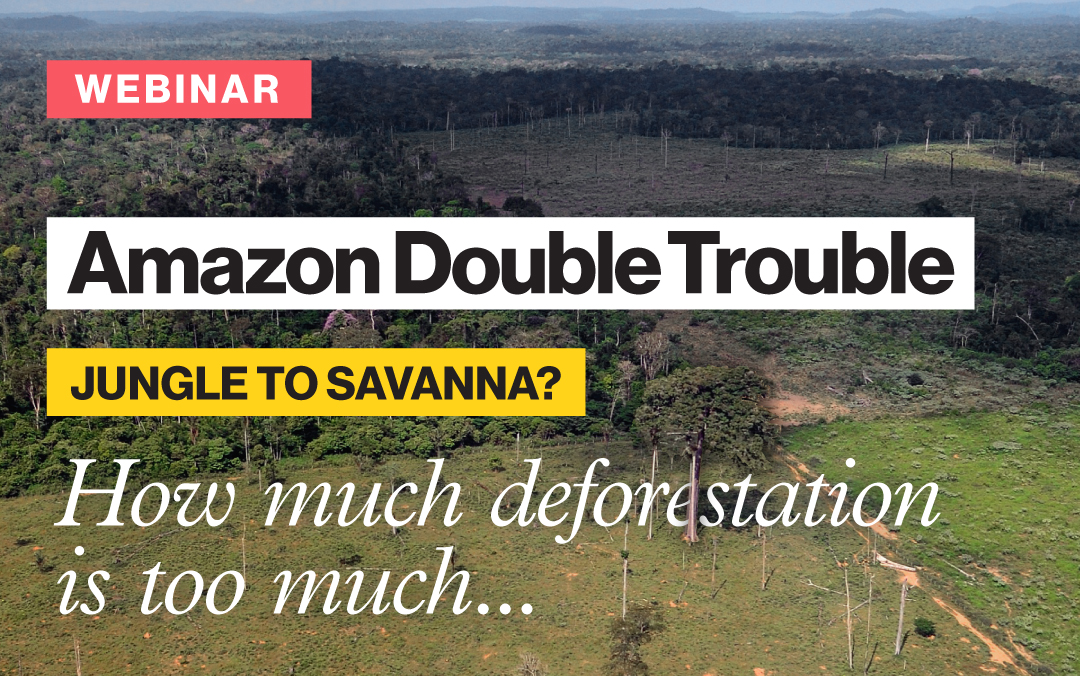
Thumbnail and opener design by Kuat Abeshev. Photo by Vinícius Mendonça/Ibama. “Novo Progresso, Pará” by Ibamagov, CC BY-SA 2.0.