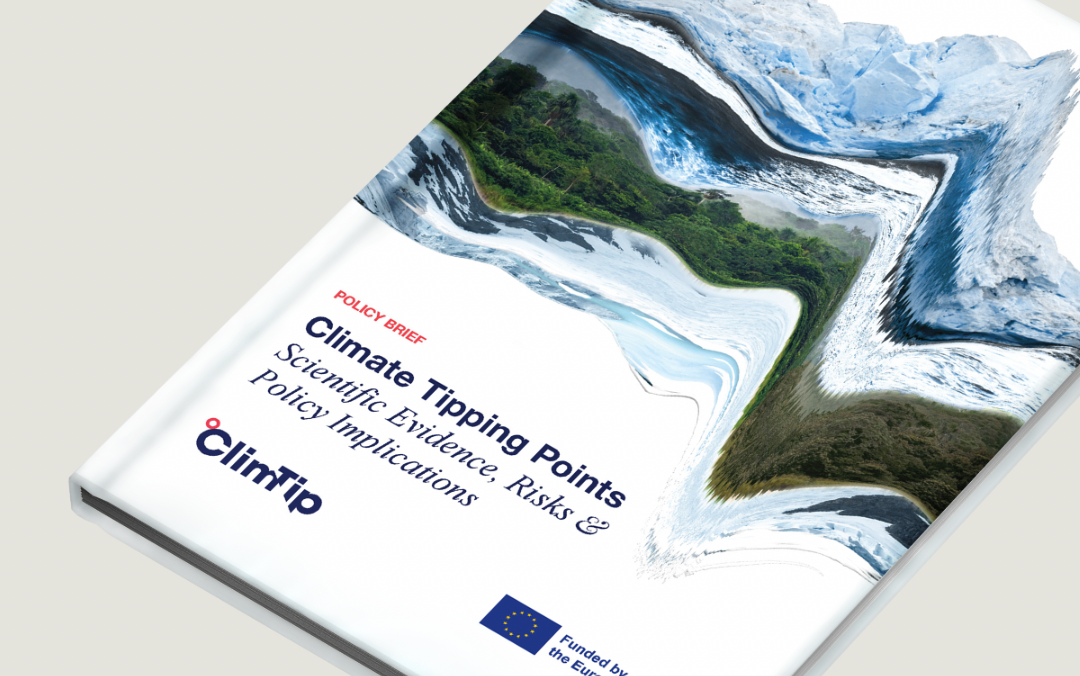

Large-scale tipping transitions in the Earth’s climate system could have severe consequences for climate, ecosystems and societies. Yet significant uncertainties remain about if, how and especially when these transitions might occur.
How should policymakers respond to risks that cannot be precisely predicted?
Published on 2 November 2026, our new policy brief, Climate Tipping Points: Scientific Evidence, Risks & Policy Implications, brings together current scientific evidence on four major tipping elements: the Greenland and West Antarctic ice sheets, the Amazon rainforest and the Atlantic Meridional Overturning Circulation (AMOC).
Based on the 13 ClimTip Key Messages, developed collectively by the consortium in 2024–2025, the brief examines the potential consequences of tipping transitions and the uncertainties surrounding their likelihood and timing.
One important finding is that both the magnitude and the rate of climate forcing can influence tipping risks. This complicates attempts to identify a single temperature threshold below which tipping can be considered impossible.
Key Message 1
Large-scale tipping transitions in the Earth’s climate system would have severe climatic, ecological and socioeconomic impacts, presenting serious and unprecedented dangers to society.
Key Message 2
We cannot precisely determine how likely tipping transitions are, but we cannot rule them out at any level of global warming.
The policy implications are clear: immediate and decisive action to reach net-zero greenhouse gas emissions reduces the risk of triggering tipping transitions.
Key Message 3
Immediate and decisive action to reach net-zero greenhouse gas emissions reduces the risk of triggering tipping transitions.
Yet some transitions could still occur after net zero because of changes already locked in.
These questions inform ClimTip's official COP31 side event, Prepared for Tipping? Adaptation and Decision Making Under Deep Uncertainty, on 19 November in Antalya, Türkiye.
Access the Full Document
This policy brief is based on the ClimTip Key Messages, developed collectively by the ClimTip consortium. It synthesizes these messages to communicate scientific evidence, risks and policy implications related to climate tipping points.
DOWNLOAD THE POLICY BRIEF

Suggested citation: Boers, N., Bathiany, S., & Abeshev, K. (2026). Climate Tipping Points: Scientific Evidence, Risks & Policy Implications. ClimTip Policy Brief. Technical University of Munich.
Image credit: Illustration and cover design by Kuat Abeshev. Incorporates photos: Greenland ice sheet by Chris Stenger; Atlantic waves by Clemens Jezler; Amazon rainforest by EcoNaturalist.com; Antarctic floating ice by 66 north; all available on Unsplash. Photographs cropped, colour-adjusted and digitally distorted.