COP31 · OFFICIAL SIDE EVENT

Prepared for Tipping?

Adaptation and Decision Making Under Deep Uncertainty

19 November  ·
13:15–14:45  ·
Side Event Room 4
AŞIK VEYSEL · Blue Zone · Antalya Expo Center

What if climate change
‍does not unfold as expected?

Climate policies and adaptation planning often assume gradual and predictable change. But Earth system tipping points can cause non-linear, irreversible change. What does that mean for the decisions we make today?
NEW PUBLICATION · 2 NOVEMBER 2026

Scientific basis for decision making

Our new policy brief brings together the ClimTip consortium's Key Messages on tipping risks and uncertainties, providing a scientific foundation for the COP31 discussion.
Download the policy brief

Perspectives on Tipping Risks and Adaptation

Science
Understanding tipping risks and uncertainties
Policy & Finance
Making decisions under deep uncertainty
Communities & Practice
Adapting to change and preparing for impacts

Speakers and Respondents

Niklas Boers
Professor of Earth System Modeling
Technical University of Munich |
Potsdam Institute for Climate Impact Research |
Munich Climate Center
Elizabeth Sellwood
Senior Advisor
United Nations Environment Programme
(UNEP)
Andrew Harper
Special Advisor on Climate Action
United Nations High Commissioner for Refugees
(UNHCR)

Meet the Panelists

Rosalind Cornforth
Professor of Climate and Development \ Director
The Pearl
University of Reading
Mikko Ollikainen
Head of the Adaptation Fund
Adaptation Fund
Abdou Ali
Director of Research
CILSS/AGRHYMET
WMO Regional Training Centre, Niger & Sahel
Florence Kuali Iautu
Strategic Manager
National Advisory Board on Climate Change and Disaster Risk Reduction, Vanuatu

Additional panelists to be announced...
‍

Panel Moderator

Kuat Abeshev
Head of Communications
ClimTip | Technical University of Munich

Co-organizers and partners

You are invited
Join us in the Blue Zone on 19 November, and stay for an informal reception afterwards.

Official UNFCCC COP31 Side Event Programme.

‍

Resources and further reading

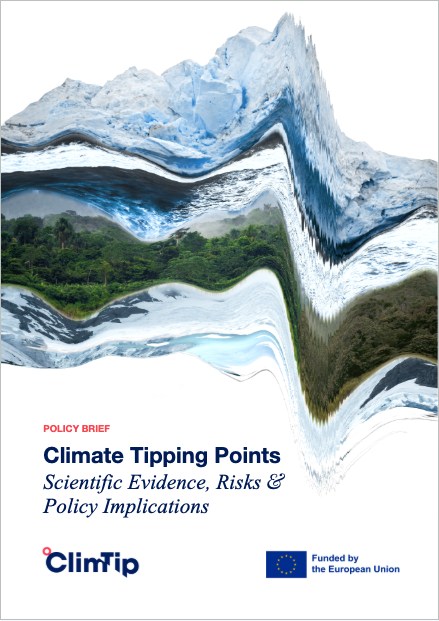
POLICY BRIEF  ·  ClimTip  ·  2026
Climate Tipping Points:
Scientific Evidence, Risks & Policy Implications.
DOWNLOAD THE BRIEF
Frequently Asked Questions
What is ClimTip?
Plus icon
ClimTip is a multidisciplinary effort dedicated to advancing our understanding and prediction of Earth's climate tipping points. Through cutting-edge research and data analysis, we strive to identify critical thresholds in the climate system, focusing on four major systems: the Atlantic Meridional Overturning Circulation (AMOC), the Greenland and West Antarctic ice sheets, and the Amazon rainforest. By developing early warning systems and conducting comprehensive assessments, we aim to mitigate the impacts of these tipping points on ecosystems, societies, and economies worldwide. Our work is crucial for fostering global awareness and collaboration in addressing the urgent challenges posed by climate tipping points. Find out more about our project.
What are the objectives of the project?
Plus icon
The primary objectives of the ClimTip project are to deepen our understanding of climate tipping points, refine predictive models, and develop early warning systems. We aim to assess the impacts of tipping events on climate, ecosystems, and society, while formulating strategies for adaptation and mitigation. Additionally, we prioritize raising public awareness about the importance and risks of climate tipping points. Read more about our science goals here.
What are climate tipping points?
Plus icon
Climate tipping points are critical thresholds in Earth's climate system where small changes can lead to significant and potentially irreversible shifts. These shifts can cause abrupt and profound changes to weather patterns, ecosystems, and human societies, with far-reaching impacts on biodiversity, agriculture, and sea levels. Understanding and addressing these tipping points is imperative for safeguarding our planet's future and fostering a sustainable and resilient world.
How close are we to crossing tipping points?
Plus icon
While scientists have identified potential tipping points in our climate system, there are significant uncertainties regarding when and how these thresholds may be crossed. These uncertainties underscores the importance of deepening our understanding of climate tipping points and developing early warning systems. The urgency lies in the fact that even small changes in global temperatures can increase the risk of triggering these critical thresholds. By actively addressing climate change and reducing greenhouse gas emissions, we can work to mitigate the risk of crossing tipping points and minimize their potential impacts on our planet.
What are the most important Tipping Elements?
Plus icon
While ongoing debates within the scientific community acknowledge uncertainties surrounding the status of various tipping elements in Earth's climate system, certain systems, such as the Atlantic Meridional Overturning Circulation (AMOC), Greenland and West Antarctic ice sheets, Amazon rainforest are widely acknowledged as critical tipping elements. The ClimTip project focuses its research efforts primarily on these major tipping elements, recognizing their paramount importance in global climate dynamics. These elements are significant due to their potential to trigger abrupt and irreversible changes, such as sea level rise, disruptions to global weather patterns, and loss of biodiversity.

Do you still have questions about ClimTip?
Get in touch
Arrow Right Icon